Rack Power Solutions for Modern AI Applications: Leveraging Intelligent PDUs And Monitoring - Thank You
EXECUTIVE SUMMARY
As AI workloads generate unprecedented power demands, hyperscale data centers face greater pressure to accommodate denser, hotter, and more energy-intensive computing environments. This paper emphasizes best practices for powering modern AI racks, focusing on intelligent rack PDUs, including updated sizing guidelines for outlets and branch circuits, power quality monitoring, and infrastructure scalability.
POWERING AI RACKS: THE NEW NORMAL
Modern AI applications, especially those involving large language model (LLM) training or real-time generative inference, are driving an explosive demand for parallel compute capacity. To meet this demand, hyperscalers are making significant investments in high-wattage GPU (Graphics Processing Unit) clusters, rapidly increasing rack power density, and reconfiguring data center floor space. In the US alone, data center energy consumption is projected to rise from 61 GW in 2025 to 130 GW in 2030 1.
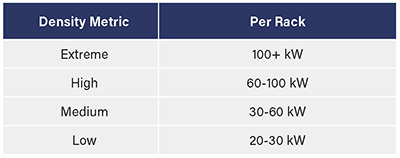
Table 1: High-Capacity Power Applications, kW per Rack
In response, data center operators must rethink their power delivery strategies at the cabinet level. While a typical rack previously supported 15-20 kW, racks supporting AI infrastructure now exceed 60 kW and can reach up to 100 kW.
1. Hering, G. and Dlin, S (2025, Oct. 14) Data center grid-power demand to rise 22% in 2025, nearly triple by 2030. S&P Global.
This change requires careful consideration of every element of the cabinet's power setup—from designing power input and heat output to monitoring and redundancy. Intelligent rack power distribution units (PDUs) supporting three-phase power, which were once passive components in a rack, now play a crucial role in maintaining uptime, efficiency, and safety. The table below highlights the maximum capacity load data for common three-phase power types typically used in racks supporting AI workloads.
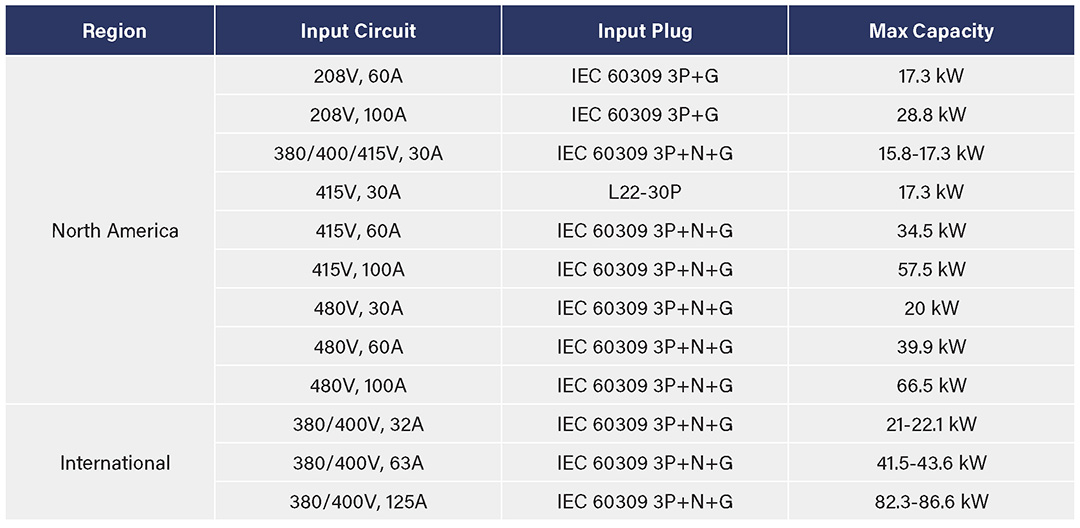
Note: Capacities are derated per UL/NEC standards by 20%.
Table 2: High Current Input Plug and Capacity
This paper discusses the electrical, physical, and management requirements for effective cabinet power management in AI deployments. It highlights the challenges unique to high-density, high-performance compute environments and presents key considerations for deploying intelligent PDUs into AI computing racks, including:
- Input power requirements for high-density AI workloads
- Outlet types for supporting higher voltage circuits
- Considerations for overcurrent protection
- Use of the rack PDU's intelligence features
- Continuous monitoring and power quality
- Installation and connectivity
- Thermal management and energy efficiency
INPUT POWER REQUIREMENTS FOR HIGH-DENSITY AI WORKLOADS
The key to supporting high-density AI racks starts with the right input power design. Cabinets need to be provisioned to handle both current and future workloads, often requiring 60–100kW of power. This power demand is typically supplied via three-phase feeds at 208V or 415V, depending on regional standards, with careful consideration given to redundancy and load-balancing strategies.
Modern AI servers often use 3+3, 4+2, or even 5+1 power supply unit (PSU) configurations to ensure failover resilience. Each configuration draws substantial current and presents unique challenges for power management. Cabinets must be powered by circuits that can support these draw profiles without compromising efficiency or fault tolerance. Ideally, input power should be scalable and modular, enabling staged buildouts and future compute refreshes.
For example, a single NVIDIA DGX H100 server can draw up to 10kW of power, and a Dell PowerEdge XE9680 may use 8kW or more, depending on its configuration. Racks with four to eight of these servers can easily surpass a continuous load of 60kW. Deployments with HPE Cray EX or Supermicro GPU platforms face similar requirements, particularly when configured with high-core-count CPUs, large memory capacities, and multi-GPU architectures. These loads require robust power feeds, ideally supported by intelligent PDUs with real-time input monitoring to ensure stability and detect usage spikes.
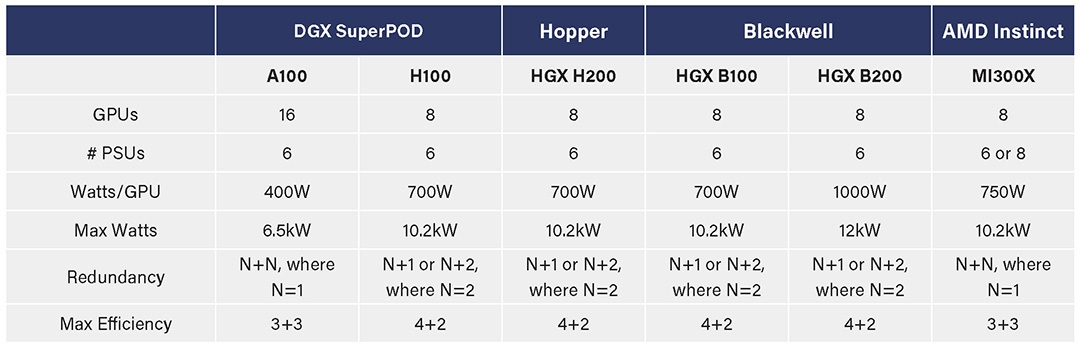
Table 3: NVIDIA GPU Comparison Table
By understanding the draw characteristics of target hardware and designing input power accordingly, data center operators can eliminate bottlenecks, reduce electrical waste, and ensure performance at scale.
RACK PDU OUTLET TYPES AND DENSITY
The diversity and intensity of modern AI equipment have led to a rethinking of PDU outlet types. Traditional IEC C13 and C19 outlets are now supplemented—or replaced—by connectors rated for 20A or more, including hybrid 2-in-1 (C13/C19) and 4-in-1 (C13/C15/C19/C21) combination outlets, Saf-D-Grid, and RF-203 sockets as examples.
C21 outlets, for instance, support the same amperage as C20 (20A/250V) but provide higher thermal ratings of up to 155°C. Saf-D-Grid and RF-203 sockets can support even higher voltage and amperage operations (480V/277V), delivering higher capacity in specific environments.
Selecting a rack PDU with the right outlet type involves balancing performance, safety, and supportability. Equally important is outlet density, as PDUs need to provide enough receptacles to accommodate all connected devices, especially in multi-GPU servers with four or more PSUs. For example, this would be a total of 24 to 48 outlets, depending on the rack height and the number of servers deployed.
Emerging server designs also need attention to outlet orientation and cord retention. In high-vibration or high-airflow environments, secure locking mechanisms may be necessary to prevent accidental disconnection. In some cases, alternating outlet orientation on vertical PDUs accommodates diverse cord entry angles, reducing strain and improving airflow within the rack.
BRANCH OVERCURRENT PROTECTION
As the power draw increases to meet the demands of AI infrastructure, the impact of circuit faults becomes more severe. Traditional 5kAIC breakers may no longer be adequate. AI deployments benefit from 10kAIC breakers or fuses, as well as intelligent circuit protection that includes alerting, metering, and post-event diagnostics.
For instance, a server with an NVIDIA® DGX A100 might draw 6.5kW through three PSUs. At 208V, that's nearly 10A per outlet. Multiply this by eight servers in a single rack, and you have dozens of high-draw outlets that require dedicated protection. In many scenarios, individual breaker protection for each outlet becomes necessary. High-density PDUs need to be equipped with adequate circuit protection and, in some designs, incorporate fuses that are more space-efficient and clear faults faster than traditional breakers.
Beyond selecting hardware, the overcurrent protection strategy needs to align with operational needs. Selective coordination between upstream and downstream breakers prevents a localized fault from escalating into a larger outage. PDU-level protection should be enhanced by detailed fault logging and integration with facility-wide monitoring to provide a comprehensive forensic trail. This approach allows for faster diagnostics, targeted maintenance, and improved uptime in mission-critical AI environments.
INTELLIGENT POWER DISTRIBUTION UNITS
The sheer complexity of AI racks necessitates PDUs that go beyond basic power delivery. Intelligent PDUs offer metering at the inlet, outlet, and branch levels, support remote switching, and provide real-time data on load, voltage, and current. Advanced models include diagnostics for power anomalies, such as crest factor, inrush current, harmonic distortion, and phase imbalance.
Phase balancing is critical in high-density deployments. An uneven load across the three phases can lead to stranded capacity and overheating. PDUs that provide per-phase monitoring help technicians to rebalance loads and maximize efficiency.
CONTINUOUS MONITORING AND POWER QUALITY AT THE RACK
Power quality is more than a facility-level concern—it is a rack-level challenge. High-performance computing equipment is susceptible to voltage dips, transients, harmonics, and imbalances. Poor power quality not only shortens the equipment's lifespan but may also lead to unexpected downtime.
Rack PDUs that support continuous power quality monitoring, such as tracking total harmonic distortion (THD), crest factor, dips, swells, and other abnormalities, facilitate predictive maintenance and early fault detection, which is especially valuable in remote or lights-out data center environments.
p>For a more thorough review of this topic, see Legrand's white papers:- Improving Data Center Reliability and Efficiency by Solving Power Quality Pain Points
- Rack PDU Power Quality Monitoring Greatly Improves Uptime
INSTALLATION AND CONNECTIVITY
AI infrastructure often deviates from legacy design standards. Dual A/B feeds are no longer sufficient. Racks may contain three or more independent power paths to support 3+3 PSU configurations. Proper installation, labeling, and cable management are essential—not only for safety, but also to facilitate maintenance and avoid accidental downtime.
Technicians also need to account for cable gauges, bend radius, airflow obstruction, and service clearances when laying out high-capacity PDUs. Color-coded PDUs, modular outlets, and flexible cable routing options can improve serviceability and minimize the risk of human error.
Additionally, as AI racks draw higher amperage, cable bundling and routing should be reevaluated to reduce thermal buildup and voltage drop. Power whips need to be properly sized and spaced to ensure safe operation and to prevent hot spots—especially in rear-of-rack configurations where airflow may be restricted. Structured cabling trays and rear-door access clearance should be designed to handle current loads and future reconfigurations without interruption.
THERMAL MANAGEMENT AND ENERGY EFFICIENCY
AI racks don't just consume more power—they also convert more of that power into heat. As rack densities increase and operating temperatures rise, precise thermal management becomes vital for both uptime and operational efficiency. Effective environmental monitoring helps data center teams optimize cooling delivery, reduce overprovisioning, and improve Power Usage Effectiveness (PUE).
Real-time sensors built for the data center should be used to monitor temperature, humidity, airflow, and pressure at both the rack and room levels. When paired with intelligent PDUs and their power quality analytics, the environmental data collected by sensors helps data center operators detect thermal hotspots early and respond dynamically. In high-density or liquid-cooled environments, rope-style and floor-mounted leak detection sensors can help prevent catastrophic failures, while airborne particle sensors alert teams to contamination risks.
ASHRAE Standard 90.4 provides guidance for maintaining efficient thermal conditions, recommending supply temperatures between 15-32°C (59-89°F) and humidity levels of 20-80% RH. Operating within this range reduces fan energy consumption and minimizes mechanical wear, but doing so safely depends on granular visibility into changing thermal loads.
By integrating environmental monitoring directly into the PDU architecture, data center operators in high-density environments not only ensure safe operating conditions but also dynamically fine-tune energy use to meet real-time demand. This approach results in a more efficient rack, a more sustainable facility, and a more responsive infrastructure.
CONCLUSION: BUILD FOR THE DEMANDS OF AI
Since the release of AI assistants and other generative AI tools, the demand for compute power has increased exponentially. New applications emerge daily across industries—from healthcare and finance to defense and retail. Supporting these applications requires careful infrastructure planning that goes beyond just selecting compute resources.
The first step in designing an AI rack is to understand the workload, including what level of CPU/GPU performance is needed and how many servers are required. Then, assess whether your existing power infrastructure—busway, RPP, etc.—can handle those demands or if upgrades are necessary.
Choose intelligent rack PDUs that match your power density and outlet type requirements, ensuring proper branch protection and failover support. Then evaluate phase-balancing, load-monitoring, and circuit-protection needs. Invest in rack PDUs that include environmental sensor support and power-quality analytics at the outlet and at the PDU inlet for better visibility and reliability.
Building a high-performance AI rack isn't just about delivering enough power. It's about delivering smart power management. By utilizing intelligent PDUs and comprehensive monitoring, data center operators can future-proof their power infrastructure for the next wave of AI innovation.
RARITAN AND SERVER TECHNOLOGY INTELLIGENT RACK POWER DISTRIBUTION SOLUTIONS
The power distribution requirements for AI workloads are rapidly evolving, and selecting the right hardware to power that infrastructure is crucial to delivering the principles outlined in this paper. Legrand's Raritan® and Server Technology® intelligent Rack PDUs are specifically designed to meet these high-density, high-reliability requirements. These platforms follow best practices by combining detailed power monitoring, advanced environmental sensing, and dynamic outlet control within a scalable and serviceable design.
The Raritan intelligent Rack PDU platform delivers high outlet density with per-outlet power monitoring, providing data center operators with real-time visibility into power consumption at the most granular level. These capabilities enable proactive load balancing and help avoid unplanned downtime in AI rack deployments, where power draw can spike unexpectedly. Combined with hot-swappable controllers and modular components, the Raritan Rack PDU simplifies serviceability even in live environments—a crucial benefit when uptime is paramount.
Meanwhile, the Server Technology intelligent Rack PDU features configurable outlet types and densities, making it easier to match the outlet configuration to evolving AI server power supply designs. Its advanced circuit protection, low-profile form factor, and seamless integration with DCIM platforms make it ideal for both new and retrofit deployments in dense, compute-heavy environments.
Together, both Raritan and Server Technology Rack PDUs offer a proven pathway to implementing the power distribution and monitoring recommendations outlined in this paper.
HIGH-DENSITY RACK APPLICATION CALLOUTS
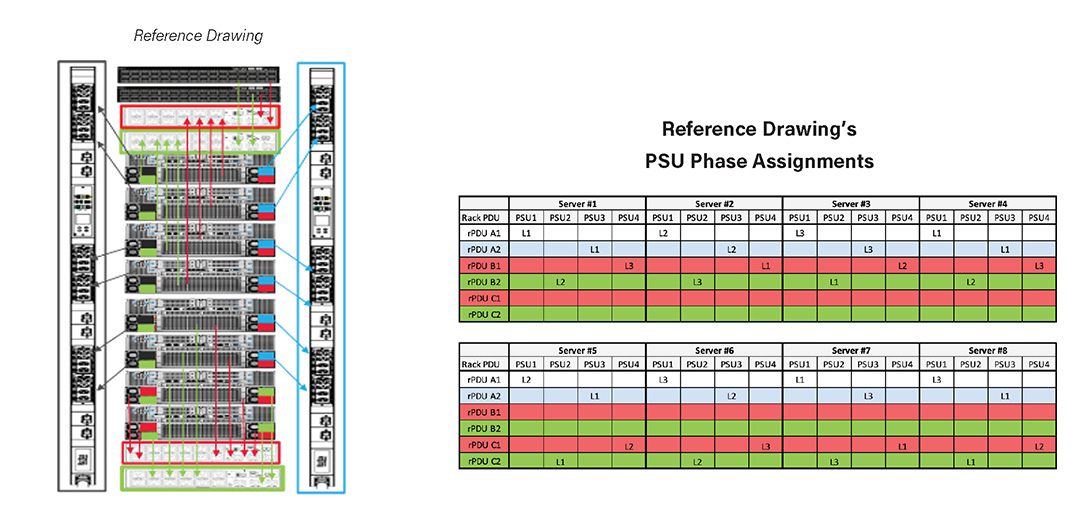
APPLICATION 1: POWERING (8) DELL POWEREDGE XE8640 ON 208V/60A
Deploying 8 x Dell PowerEdge XE8640 servers in a single rack at 208V can easily exceed 60kW, challenging traditional power delivery architectures and physical space constraints.
Legrand's Rack Power Solution
- This configuration fits within standard 42U and 45U racks, providing reliable power distribution with intelligent monitoring and redundancy, as well as comprehensive environmental monitoring.
- Vertical Rack PDUs
- Option 1: 2 x Raritan PX4-5551-E7V2 PDUs (0U, Outlet Metered with Outlet Control PDU, 208V, 3Φ Delta, 48A, 17.3kVA),
- Option 2: 2 x Server Technology C4G36RA-DQBD2FE1 PDUs (0U, Switched POPS PDU, 208V, 3Φ Delta, 48A, 17.3kVA),
- Horizontal Rack PDUs
- 2 x Raritan PX4-5529R-E8V2 PDUs (2U, Outlet Metered with Outlet Control PDU, 208V, 3Φ Delta, 48A, 17.3kVA), to deliver robust capacity in a compact 2.2 in. x 2.6 in. form factor
- Environmental Monitoring
- 1 x DX2-T1H1 Temperature/Humidity SmartSensor to monitor and record temperature and humidity data
- 1 x DX2-WSC-100-KIT Water/Leak Rope SmartSensor to detect the presence of water/glycol leaks, as well as marking the specific location of the leak
- 1 x DX2-VBR Vibration SmartSensor to detect shock and vibration over a range of frequencies
APPLICATION 2: POWERING (6) DELL POWEREDGE XE9680 ON 415V/60A
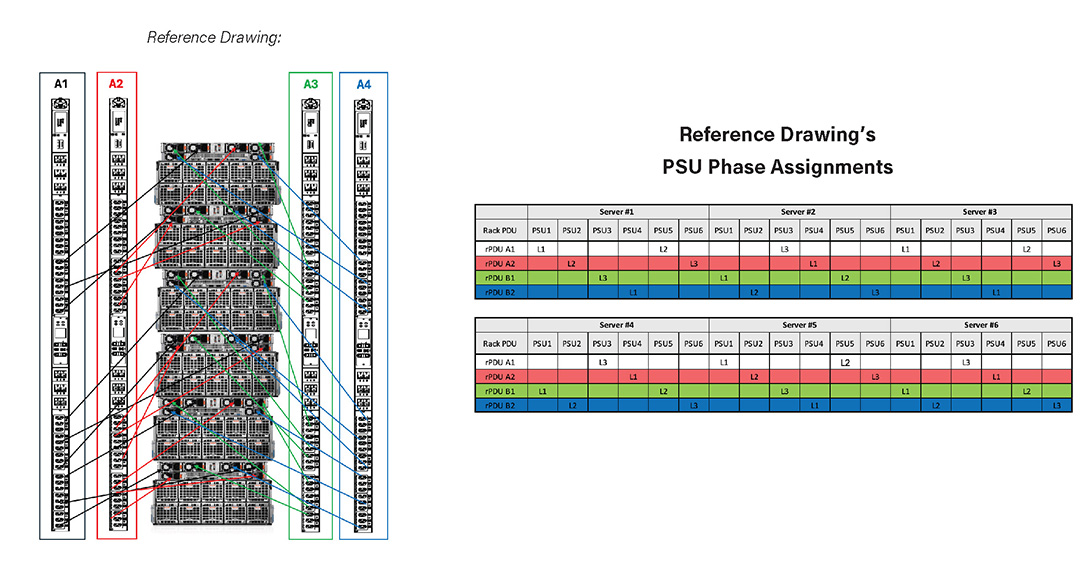
Deploying the Dell PowerEdge XE8640's high compute density and 415V power draw creates challenges for phase balancing, outlet compatibility, and breaker coordination. The recommendation is 5+1 for redundancy.
Legrand's Solution
- This solution enables seamless integration into AI-ready environments operating at higher voltage levels, while ensuring comprehensive environmental monitoring.
- This solution assumes that N rack PDU redundancy is not required. If PDU redundancy is required, then 6 x PDUs are needed to manage 5 + 1 PSU redundancy.
- Color-coded feeds and modular breaker options across both configurations support future scalability and reduce human error during installation or maintenance.
- Vertical Rack PDUs
- 4 x Server Technology C4G36RC-GSBD2FAX PDUs (0U, Switched POPS PDU, 400-415V, 3Φ Wye, 60/63A) offer a compact 2.2 in. x 3.0 in. profile with high-density outlet arrangements and advanced circuit protection, supporting stable operation across 42U-48U racks
- Environmental Monitoring
- 1 x DX2-T1H1 Temperature/Humidity SmartSensor to monitor and record temperature and humidity data
- 1 x DX2-WSC-100-KIT Water/Leak Rope SmartSensor to detect the presence of water/glycol leaks, as well as marking the specific location of the leak
- 1 x DX2-VBR Vibration SmartSensor to detect shock and vibration over a range of frequencies
APPLICATION 3: POWERING (4) GPU SUPERSERVER SYS-822GS-NB3RT ON 415V/100A
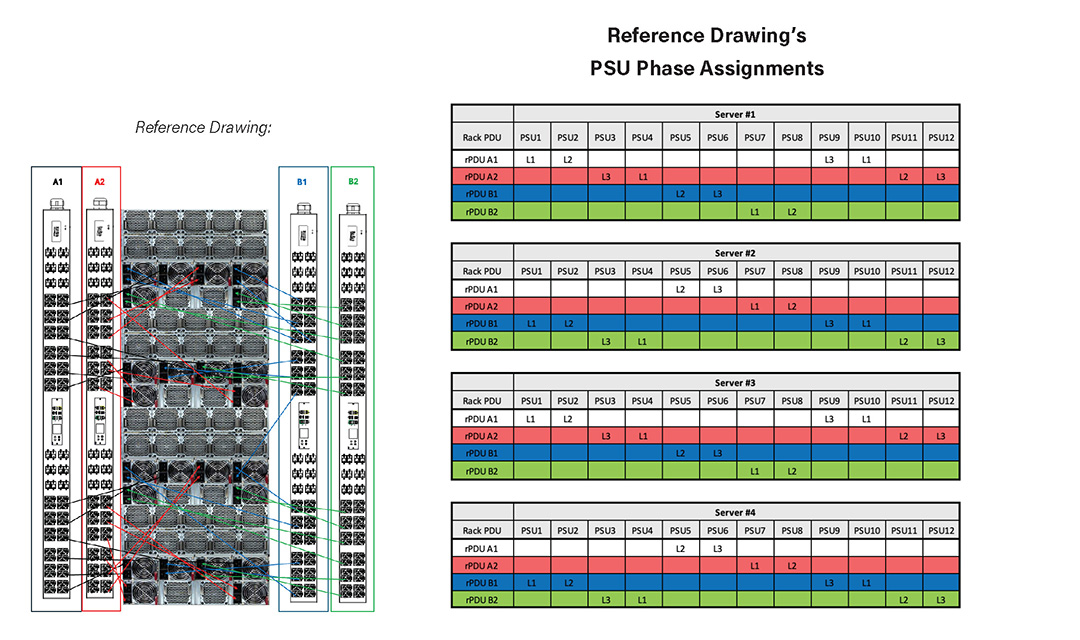
Deploying Supermicro GPU SuperServer SYS-822GS-NB3RT has high compute density and a 415V power draw, posing challenges for phase balancing, outlet compatibility, and breaker coordination.
Legrand's Solution
- This solution enables seamless integration into AI-ready environments operating at higher voltage levels, while ensuring comprehensive environmental monitoring. Server needs 3+3 PSU redundancy and rack supports N+N redundancy.
- Vertical Rack PDUs
- 4 x Raritan PX4-57A3I2U-E7V2 PDUs (0U, Input Metered PDU with Outlet Control, 415V, 3Φ Wye, 100A, 57.5kVA)
- Environmental Monitoring
- 1 x DX2-T1H1 Temperature/Humidity SmartSensor to monitor and record temperature and humidity data
- 1 x DX2-WSC-100-KIT Water/Leak Rope SmartSensor to detect the presence of water/glycol leaks, as well as marking the specific location of the leak
- 1 x DX2-VBR Vibration SmartSensor to detect shock and vibration over a range of frequencies
Learn more and connect with us today!
-

Product Selector
Find the right PDU for your data center.
View the Product Selector -

Have a Question?
Submit your inquiry and connect with us today.
Contact Us -

Rack PDU Blog
Check out our latest blogs for industry news and product information.
Learn More